


Hey there! I'm a supplier of disposable non-woven sleeves, and today I wanna chat about the elasticity of these handy products.
First off, let's understand what we mean by "elasticity" when it comes to disposable non-woven sleeves. Elasticity, in simple terms, is how well a material can stretch and then go back to its original shape. For disposable non-woven sleeves, this property is super important for a bunch of reasons.
In the market, there are different types of disposable non-woven sleeves that have varying degrees of elasticity. Take the Sunscreen Sleeve for example. These sleeves are designed to protect your arms from the sun's harmful rays. A good amount of elasticity in these sleeves ensures a snug fit on your arms. When you put them on, they can stretch to go over your hand and then fit nicely around your forearm and upper arm. This snug fit not only makes sure that the sleeve stays in place but also maximizes the sun protection it offers. If the sleeve doesn't have enough elasticity, it might be too loose and could slide down, leaving parts of your arm exposed to the sun.
Then there's the Disposable Thickened Dust-proof Non-woven Sleeve. These sleeves are used in various industries where dust protection is crucial, like construction, woodworking, and some manufacturing processes. Elasticity here plays a key role in keeping the dust out. A sleeve with proper elasticity can fit tightly around the wrist and the upper arm, creating a barrier that prevents dust particles from getting inside. Without sufficient elasticity, dust could easily seep in through the gaps, defeating the purpose of using the sleeve.
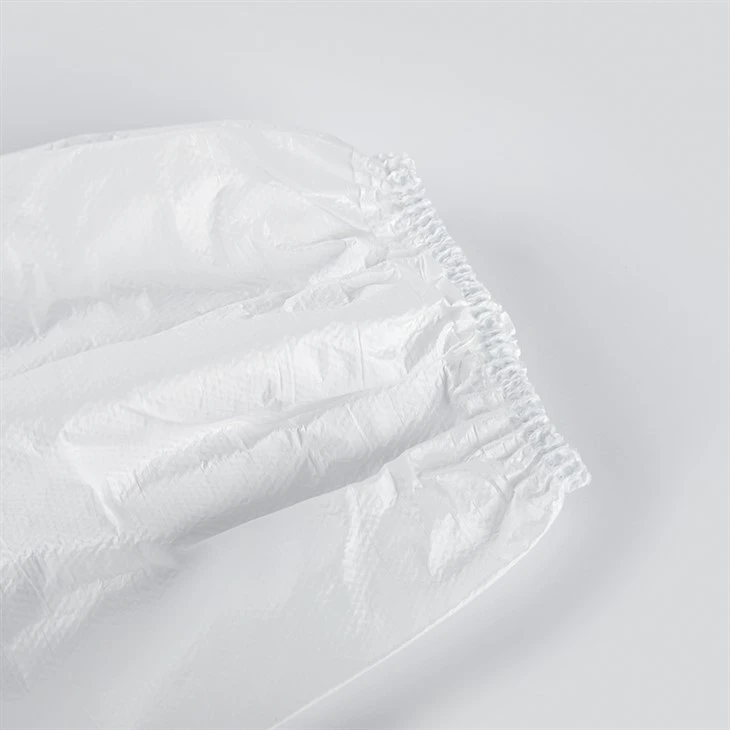
Now, let's talk about how the elasticity of disposable non-woven sleeves is achieved. It all starts with the materials used. Non-woven fabrics are made from fibers that are bonded together in different ways. To add elasticity, manufacturers often incorporate elastic fibers or use special bonding techniques. Some sleeves might have a small amount of elastic thread woven into the fabric around the edges, like at the wrist and the opening at the top of the sleeve. This gives the sleeve that extra stretch and the ability to snap back into place.
The manufacturing process also affects the elasticity. For instance, the way the non-woven fabric is heated and pressed during production can change its physical properties. If the fabric is heated at the right temperature and pressure, it can develop a better stretchability. However, if the process is not well-controlled, the sleeve might end up with uneven elasticity. Some parts could be too stretchy while others are too tight.
Another factor that impacts elasticity is the thickness of the non-woven material. Generally, thicker sleeves might have less elasticity compared to thinner ones. But this isn't always the case. Some manufacturers have developed techniques to make thick non-woven sleeves with good elasticity. They might use a combination of different fibers or a unique bonding method to achieve this.
When it comes to testing the elasticity of disposable non-woven sleeves, there are a few standard methods. One common way is to use a tensile testing machine. This machine grabs the sleeve at both ends and slowly pulls it apart, measuring how much it stretches and how much force is needed to do so. It also checks if the sleeve can return to its original length after being stretched. A good quality sleeve should be able to stretch a certain amount and then go back to almost its original size without any significant deformation.
Now, as a supplier, I know that customers have different needs when it comes to the elasticity of disposable non-woven sleeves. Some might need a very stretchy sleeve for a specific application, like for people with larger arms or for jobs that require a lot of arm movement. Others might prefer a less stretchy but more durable sleeve. That's why we offer a range of products with different levels of elasticity.
We work closely with our customers to understand their requirements. If you're in the sunscreen sleeve market, we can provide sleeves with just the right amount of stretch to fit comfortably on different arm sizes while still providing excellent sun protection. And if you're in an industry that needs dust-proof sleeves, we can offer options that have enough elasticity to create a tight seal against dust.
Our quality control team is constantly monitoring the elasticity of our products. We test samples from each batch to make sure they meet our high standards. This way, you can be confident that when you order from us, you're getting disposable non-woven sleeves with consistent and reliable elasticity.
If you're in the market for disposable non-woven sleeves, whether it's the Sunscreen Sleeve or the Disposable Thickened Dust-proof Non-woven Sleeve, I'd love to have a chat with you. We can discuss your specific needs, and I'm sure we can find the perfect sleeve for your application. Just reach out, and we can start the conversation about getting you the best disposable non-woven sleeves with the right elasticity.

References
- Textile Testing Handbook, various editions
- Industry reports on non-woven fabric manufacturing